
The 5 Best Practices for Airport Content All Start with Content Designed for Engagement

At Synect, we’ve long believed that the future of digital signage for airports is about much more than signage. It’s about communication that creates engagement.
Understanding the difference is essential for building better airport content.
Traditional digital signage is often passive. A screen goes up, content goes on it, and maybe that content changes on a schedule. The message is considered delivered regardless of engagement or response.
Passengers need more than passive messaging. Many of them see airports as high-pressure, fast-paced environments that require constant, quick decision making. Without the right support, passengers can quickly become overwhelmed and unhappy.
Airports need strategic content to engage passengers, support their changing needs, and influence behavior in real time.

Through our work creating pioneering passenger communication solutions, we’ve seen that the most effective airport communication is built on content-first strategy.
Here are five best practices that define that you can start using today to create better content.
Move Beyond Passive Messaging
Passive messaging assumes people will look, absorb, and act. In reality, passengers are often distracted, rushed, or overwhelmed.
If content doesn’t earn their attention, it can’t make an impact.
Our first best practice for airport content is simple: design for engagement, not display.
Synect creates attention-grabbing, behavior-influencing content using our three-stage framework: attract, relate, and engage.
As shown in the above excerpt from our 2025 FTE Panel, his framework creates content that performs in real life environments. Rather than just being seen, the content is easily understood and acted upon.
Attract Attention in the Right Moment
Timing matters just as much as, if not more than, messaging.
Passengers’ needs change as they move through each part of the airport. Their needs at curbside, check-in, security, and the gate are all unique.
Content that works in one location may be ignored in another. Even worse, irrelevant content can become overwhelming visual noise.
Effective airport content meets passengers where they are.
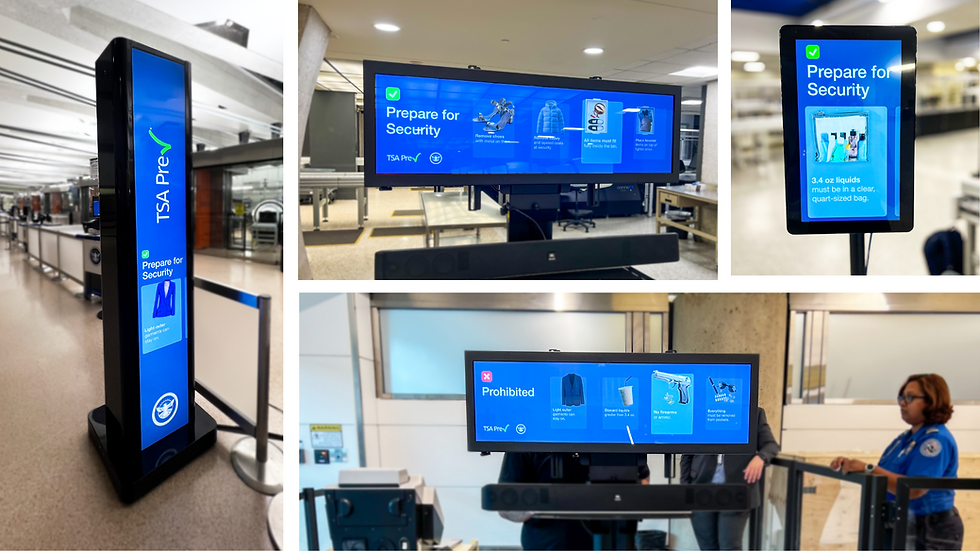
When content aligns with context, engagement increases. Real-time updates, such as wait ties in the security line, make content hyper-relevant, helping passengers prepare for crowding and delays before they encounter them.
Relate to Passengers’ Needs
For content to work, it must be relevant. Passengers are more likely to act when they understand how it will benefit them, as shown by our work with Evenflow Crowd Radar.

Messaging tied to personal and communal benefit drives stronger responses. When passengers understand how an action will save them time, reduce stress, or help others, they’re more likely to change their behavior.
Relatable content speaks to passengers’ immediate needs in simple, human language. It draws clear connections between action and outcomes.
In busy airport environments, this clarity builds trust, reduces passenger anxiety, and drives movement.
Engage Passengers to Influence Behavior
Strong airport content sets itself apart by driving action. Simply capturing passengers’ attention isn’t enough. It needs to measurably influence their behavior.
Effective airport content should work at a glance. Passengers don’t always have time to interpret complex visuals or decode dense text. Every piece of content must communicate instantly.
To do so, airport content should:
Use motion strategically to draw the eye
Prioritize high-contrast, high-visibility design
Maintain consistent visual language across touchpoints
Deliver a clear, singular direction
Exhibit clear information heirarchy
Use icons, color, and other visual indicators effectively

Design is the first level of driving engagement. The most effective content strategies are dynamic. They adapt to real-time conditions, such as crowding or delays, and update to help passengers adjust their course of action. These changes make content a key operational tool rather than a simple communication layer.
When content is engaging, contextual, and responsive, it informs and influences passengers. It creates better experiences and better outcomes for everyone.
Keep Communication Clear and Focused

Even the best content can fail if it’s competing with too much noise.
Airports are filled with competing visuals, busy signage, advertisements, and announcements. They’re all vying for passengers’ attention, and the noise can quickly overwhelm passengers.
Clarity is essential. Strong airport content focuses on a single message. There should be no distractions. Information should follow a clear hierarchy. Text should use readable typography. Accessibility must be a priority.
Simplicity isn’t a limitation. It makes communication effective.
The Future of Airport Content is Built on These Best Practices
Airport content has evolved from noisy, static messaging to sleek, dynamic visual communication. The best practices for airport content are centered around creating meaningful engagements, not filling screens.
Content is a key operational tool. It helps passengers make better decisions, supports airport operations, and improves every passenger experience.
If you’re ready to create high-impact content, speak with our team today.


